“Without faith, the cross is only wood”
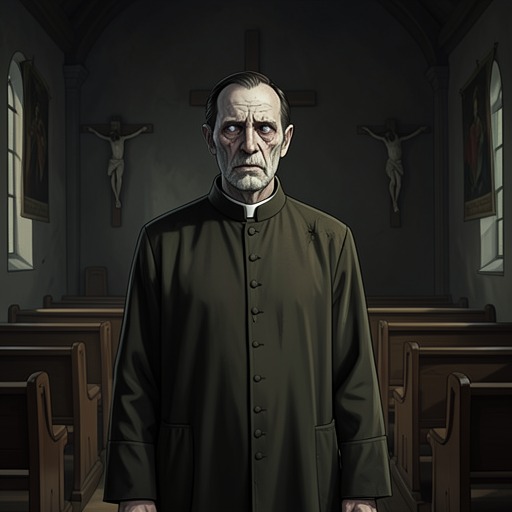
'Salem's Lot: A Novel“Without faith, the cross is only wood” expresses the novel’s rule that religious symbols derive their power through faith rather than material substance. Its decisive significance appears when Father Donald Callahan faces Sarlinov: the cross first functions as a weapon against supernatural evil, but when Callahan’s faith fails, its light and force vanish, leaving him exposed.
Meaning and Material Contrast
The expression rejects the idea that a cross works automatically as a magical object. Sarlinov explains the principle through a chain of material contrasts: the cross is only wood, the flag only cloth, the bread merely baked wheat, and the wine only sour grapes. Each object retains its physical form, but its sacred or protective meaning depends on the belief invested in it. The statement therefore separates matter from religious significance without denying the latter; the symbol can become powerful, but not independently of faith.
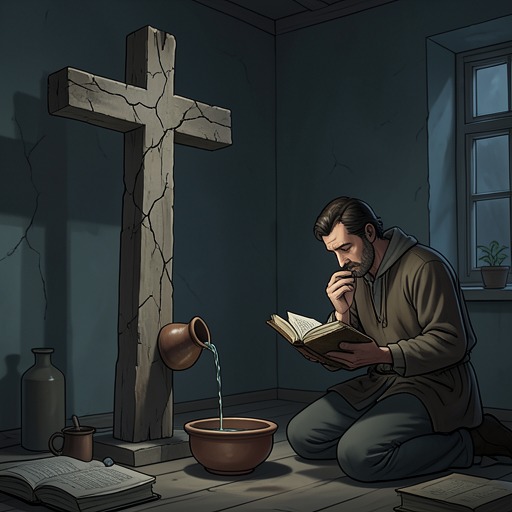
The scene makes the doctrine concrete by describing Callahan’s cross as a piece of plaster bought by his mother in a Dublin souvenir shop. Its humble origin intensifies the contrast between physical object and spiritual force. Earlier, it had sent power up Callahan’s arm with enough apparent strength to smash walls and shatter stones. Once that power is gone, the same cross has not changed materially; only Callahan’s relation to it has changed.
The Confrontation with Sarlinov
The maxim is spoken during a reversal in Callahan’s struggle with Sarlinov. Callahan commands the vampire to stay back in the name of God, but the cross’s glow is dying. As Callahan retreats until his body strikes the kitchen table, Sarlinov advances with amusement, treating the priest’s weakening faith as the decisive fact of the encounter. The protective value of the cross shifts from active defense to helpless material presence.
The loss is rendered as both physical and psychological. The cross trembles in Callahan’s hand, then all its light disappears; the muscles in his arm remember the former power but cannot reproduce it. Afterward, the cross falls to the floor, and Sarlinov uses the moment to restate the doctrine. He points out that Callahan might have defeated him on another night had he dropped the cross earlier, but that the object cannot save someone who no longer believes in what it signifies.
Sarlinov’s explanation is also a form of psychological domination. He speaks from the darkness while Callahan cannot locate him, turning the failed symbol into part of a cat-and-mouse game. The vampire does not merely overpower Callahan physically; he forces the priest to experience the collapse of the system by which Callahan has understood protection, authority, and sacred power.
Faith, Symbols, and Consequences
The expression establishes a broader operating rule for the supernatural conflict. Religious objects are not effective through their construction alone, and neither a cross nor another emblem can substitute for the act of faith. The episode consequently makes spiritual conviction an active power with practical consequences rather than a private attitude detached from events.
At the same time, the scene gives the rule an agonizing paradox. Callahan knows the doctrine intellectually, yet knowledge does not prevent fear from overwhelming him. The cross’s former force is remembered in his body, but memory cannot recreate belief. The gap between what the symbol means and what Callahan can presently sustain becomes the source of his vulnerability.
The phrase also gains force through Sarlinov’s deliberate comparison of Christian objects. The cross, flag, bread, and wine belong to different domains, but his formulation places them within one semiotic structure: each is ordinary matter until a system of belief gives it a larger meaning. In this confrontation, the vampire exploits that structure rather than simply dismissing it. He acknowledges the cross’s power when faith is present, then turns the same principle against the priest when faith fails.
Narrative and Thematic Significance
As a close-reading principle, the expression links external object and inward conviction. The cross is neither presented as permanently magical nor reduced to meaningless decoration. Its status changes according to the spiritual condition of the person wielding it, so the scene dramatizes faith as a force that must be enacted continuously rather than possessed once and for all.
The line also crystallizes the novel’s contrast between symbolic authority and supernatural predation. Callahan’s command invokes God, but the command cannot hold while the material sign in his hand has lost its meaning for him. Sarlinov’s victory in the moment therefore exposes a crisis of faith as much as a physical defeat. The ordinary object remains, but the protection associated with it has become inaccessible.
By making a failed cross the center of the scene, the narrative turns doctrine into action. The principle is not offered as abstract theology; it governs whether Callahan can resist an advancing vampire. The cross’s extinguished light marks the scene’s decisive value shift: sacred protection becomes helplessness, confidence becomes terror, and an instrument of resistance becomes only plaster in the hand of a frightened man.